A beginner’s guide to the Tour de France
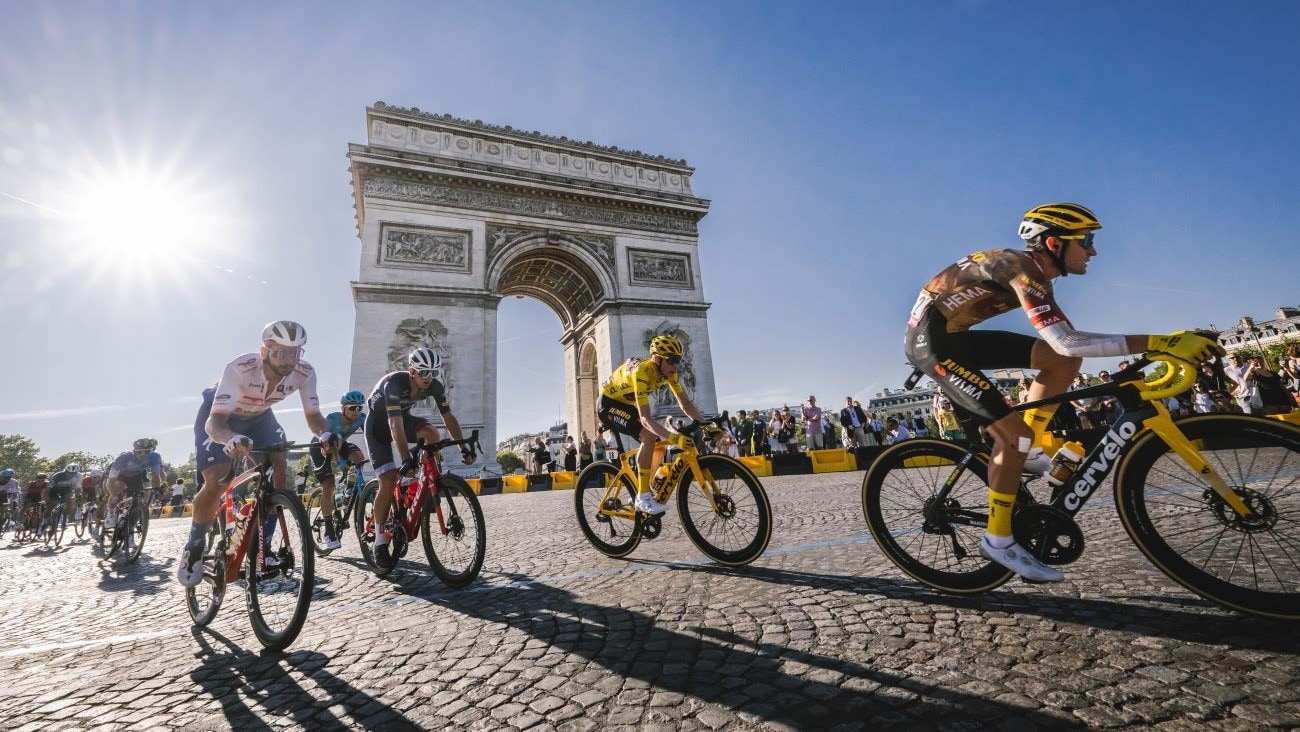
Image credit: Pauline Ballet, A.S.O.
It’s Tour de France time. On 5 July some 184 riders from 23 teams will line up for a Tour rich in history, challenge, and all-French scenery.
If you're watching the Tour de France for the first time, you might be wondering what exactly is going on. Why are some riders sprinting ahead while others hang back? What's with the different coloured jerseys? And how can someone win the Tour without winning a single stage?
To help you out we’ve put together a bit of a guide to help you understand the basics so you can really enjoy the spectacle, drama and strategy of the world’s most famous cycling race.
The Tour de France is a three-week-long cycling race held every July and is one of cycling’s three Grand Tours, along with the Giro d’Italia and the Vuelta a España. It’s by far the most famous. Riders cover more than 3,000 kilometres across France and sometimes into neighbouring countries. The race includes flat stages, mountain climbs, individual time trials and a final parade stage into Paris.
The winner is not the rider who crosses the line first each day. The overall winner is the rider with the lowest cumulative time over all 21 stages.
Image credit: ASO
The 2025 Tour de France will stay entirely within France, a first since 2020. Covering 11 regions and 34 departments, the race features 21 stages: seven flat, six hilly, six mountain stages with five summit finishes, and two individual time trials. Riders will get just two rest days across the three-week event. Phew! That’s a lot of peddling.
This year, eight new stage towns will join the Tour, including Lauwin-Planque, Bayeux, Chinon, and Vif. Mountain stages will cover the Massif Central, Pyrenees, Alps, and Jura, with the Col de la Loze (2,304m) marking the highest point that’ll be climbed from the east for the first time.
The total elevation gain is a punishing 52,500m.
So now let’s get back to our guide to help you better enjoy the big race.
The Tour is raced in teams, usually made up of eight riders each. Teams include star riders, climbers, sprinters and support riders known as domestiques. Each team has a strategy, and while one rider may be the team’s designated leader, the rest work to support and protect them. That could mean blocking the wind, pacing them up a climb or chasing down a breakaway. See, there’s a method to the apparent madness behind it all.
Although individual cyclists may get the media attention, professional cycling is very much a team sport.
One of the most recognisable symbols of the Tour de France is the yellow jersey, or maillot jaune. This is worn by the overall race leader, the rider with the lowest total time across all completed stages.
Also watch out for these jerseys:
- Green jersey (maillot vert): Awarded to the best sprinter. Riders earn points for high finishes on flat stages and for intermediate sprints during a stage.
- Polka dot jersey (maillot à pois rouges): Worn by the best climber. Points are awarded for reaching the summits of categorised climbs first.
- White jersey (maillot blanc): For the best young rider, aged 25 or under, in the overall standings.
Jerseys can change hands from day to day, depending on performances.
Tour de France 2024 , Stage 4 Pinerolo to Valloire with Richard Carapaz in the yellow jersey
Image credit: ASO/Billy Ceusters
Not all stages are the same. Understanding the stage type helps you know what to expect each day.
These usually favour sprinters and often end in a high-speed bunch sprint.
These are the toughest days and are where large time gaps often appear. The climbs can be long, steep and punishing, especially in the Alps and Pyrenees.
Riders compete individually against the clock. There are usually one or two of these in the Tour, and they can be crucial for the general classification.
These are less extreme than mountain stages but still challenging. They often suit breakaway riders or all-rounders.
Tour de France 2024 – Stage 17 – Saint-Paul-Trois-Chateaux to Superdeoluy.
Image credit: ASO/Charly Lopez
Most of the race is ridden in a large group known as the peloton. Riding in the peloton helps riders conserve energy, as they can draft behind others and reduce wind resistance.
Sometimes, a few riders will try to get ahead in what is called a breakaway. These riders go clear of the peloton and try to stay away until the finish. Sometimes they succeed, but more often the peloton catches them before the end. Breakaways can also be tactical, aiming to gain points for the mountain or sprint classifications.
This is perhaps the most misunderstood aspect of the Tour de France. The race is not won by the rider who wins the most stages. It’s won by the rider with the lowest total time over the entire race. This is known as the general classification (GC).
That means a rider could win no stages at all and still earn the yellow jersey by finishing consistently near the front and avoiding big time losses. So, the aim is to manage energy levels, ride smart and avoid crashes as well as being fast.
You may notice that TV coverage often shows time gaps between riders or groups. This is because these time gaps are added to or subtracted from a rider’s total time. Remember the definition of winning – it’s the lowest total time.
On certain stages, time bonuses are awarded to the top three finishers. These are small deductions from a rider’s overall time and can make a difference in a tight race. You may also hear about time cuts. This refers to riders who finish too far behind may be eliminated, especially on mountain stages.
A team’s racing strategies vary by rider and stage type. For example, sprinters save their energy on mountain days and climbers stay safe on flat stages. Some riders target specific stages that suit their strengths. Others have an eye on the overall standings and conserve energy to ensure they peak at the right time.
Different riders also have different goals. Some want to win stages; some are chasing a jersey, and a few are going for the overall win. You may even see riders sacrificing their own chances to help a team-mate succeed. That’s true teamwork.
Here are a few ways to make the most of watching the Tour on television:
- Look at the stage profile before tuning in. It will tell you whether to expect a sprint finish, a mountain battle or a solo time trial.
- Watch the jersey competitions, especially the yellow and green jerseys, as these are closely contested.
- Learn a few of the top riders’ names, especially the favourites for overall victory.
- Listen to the commentators, who explain the race tactics and background stories as they unfold.
- Be patient. The race builds over three weeks, and the storylines become more exciting each day.
Tour de France 2020 – Stage 9 – Paul to Laruns with Kasper Asgreen in front.
Image credit: ASO/Alex Broadway
Tawfiq Choudhury, Lead Analyst - Channel and Customer Insights at Optus watches each Tour de France. He’s been watching the Le Tour for several years now but was not always interested in cycling. We spoke to him to find out how he became a such a superfan.
“I never thought I’d be into cycling. The Tour de France, to me, was just a bunch of guys riding bikes in tight outfits through lovely European locations. It looked exhausting and confusing, and to be honest, I didn’t see the appeal. But one July afternoon, I saw a stage on TV. A rider was working his way up a mountain alone while the main group, the peloton, chased him down. The commentators were talking about tactics, wind resistance, energy management, and I found myself oddly intrigued. I watched a bit longer. The next day, I tuned in again,” Tawfiq said.
“Soon I was looking things up to find out more. What exactly is a ‘domestique’? How can someone win the entire race without winning any individual stages? Why do some riders push at the front only to fall back later?
“It was like a giant puzzle, and the more I learned, the more hooked I became. The Tour isn’t just about speed. It’s about timing, teamwork, sacrifice and resilience. It reminded me of chess, only played on wheels. And a lot like life itself. Sometimes you sit back and conserve. Other times you take your chance and go for it.
“What surprised me is how you get drawn into the emotion of it all. You find yourself starting to follow the riders' stories, their injuries, comebacks and near misses. You cheer for the underdog in a breakaway and feel the tension build during the flat-out sprint finishes. So, each stage has a story of its own. Once you understand the tactics and roles, everything becomes more meaningful. It’s not the chaos that I once thought it was. It’s calculated, and every effort has a purpose,” he said.
“Now, I watch the highlights every year with my two sons.
We discuss things and they ask me stuff. They don’t watch live as it starts very late at night in Australia. We watch the highlights together and I usually watch the Queen stage live (this is usually where the highest climb is and usually decides the race winner but not always).
“What began as a curiosity has turned into a family tradition. We sit together, picking our favourite teams, predicting winners, discussing team strategies and learning more with each passing year. Sometimes we pause the recording to explain things,” Tawfiq said.
“And actually, the Tour is teaching my sons lessons beyond cycling. They’re learning that hard work behind the scenes matters, that helping someone else can be just as important as winning yourself, and that perseverance pays off.
“I never expected to love a sport I once knew nothing about. But now, when July comes around, we’re ready. It’s not just a bike race. It’s a reminder of how effort, patience and unity can lead to something unforgettable. Now we look forward to watching the Tour de France together,” Tawfiq said.
Heading to France for the Tour de France check out Optus International Roaming.
International Roaming
Optus Daily Roaming lets you connect in 110+ destinations.
For just $5, get 5GB data to use in 24 hours.
Available on Choice Plus plans. T&Cs apply.
Black Friday tech deals: when do Black Friday sales start?
12 October 2026
Black Friday tech deals are almost here. This is what you need to know about the big annual sales event.
EOFY scams: how to stay safe
7 October 2026
Stay safe this EOFY season – protect yourself from EOFY scams and read up on the tactics of scammers.
More than a game: celebrating the community spirit of the Koori Knockout
6 October 2026
We’re proud to show up for important events like the Koori Knockout.